Project (Master Thesis)
StoryGen AI
AI-assisted narrative generation system designed to support game designers in creating branching story structures through structured graphs, validation rules, and controlled LLM-based generation.
StoryGen AI explores how Large Language Models can support the creative workflow of game and narrative designers when building complex, branching stories for video games. The system focuses on structured co-creation rather than fully autonomous generation, keeping human authorship at the center of the design process.
My Contributions
- Designed and implemented the AI-driven narrative generation pipeline
- Developed graph-based story representations using acts, nodes, quests, and branching paths
- Implemented prompt engineering strategies for controlled and structured narrative output
- Designed validation rules to ensure structural consistency and logical coherence
- Developed backend services in Python for generation, orchestration, and asynchronous processing
- Integrated the system with an Unreal Engine frontend for interactive exploration and visualization
- Designed export-ready narrative outputs for use in game development workflows
Overview
The project addresses one of the core challenges of modern narrative game development: managing complexity while preserving coherence, player agency, and creative control across long branching storylines. Instead of replacing the designer, the system acts as a structured support tool for brainstorming, story prototyping, chapter planning, and consistency checking.
System Architecture
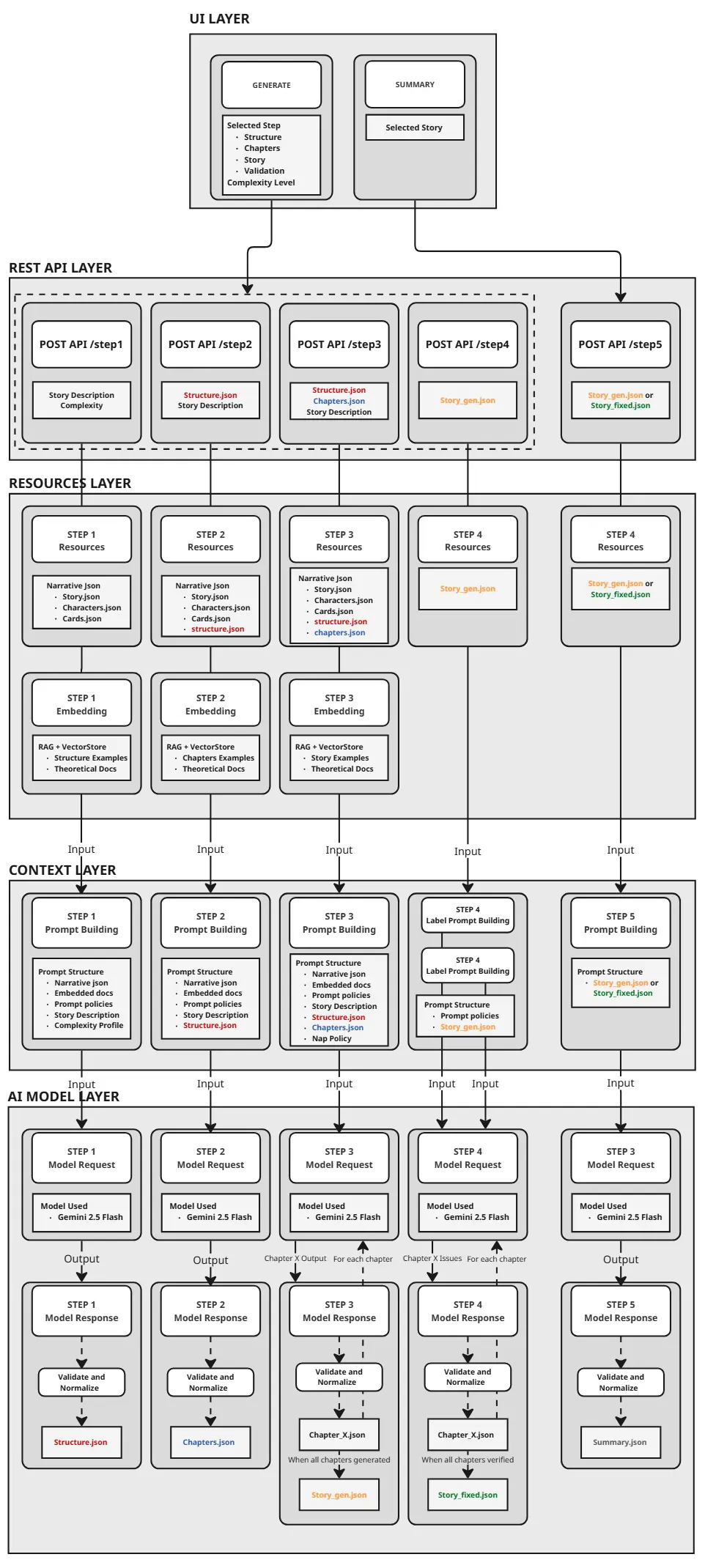
The architecture is built around a multi-step generation pipeline that separates the narrative process into distinct stages, including structural generation, chapter breakdown, detailed expansion, automated validation, and final synthesis. This staged approach reduces the weaknesses of raw LLM generation in long-form storytelling and improves consistency across the final narrative output.
Narrative Representation
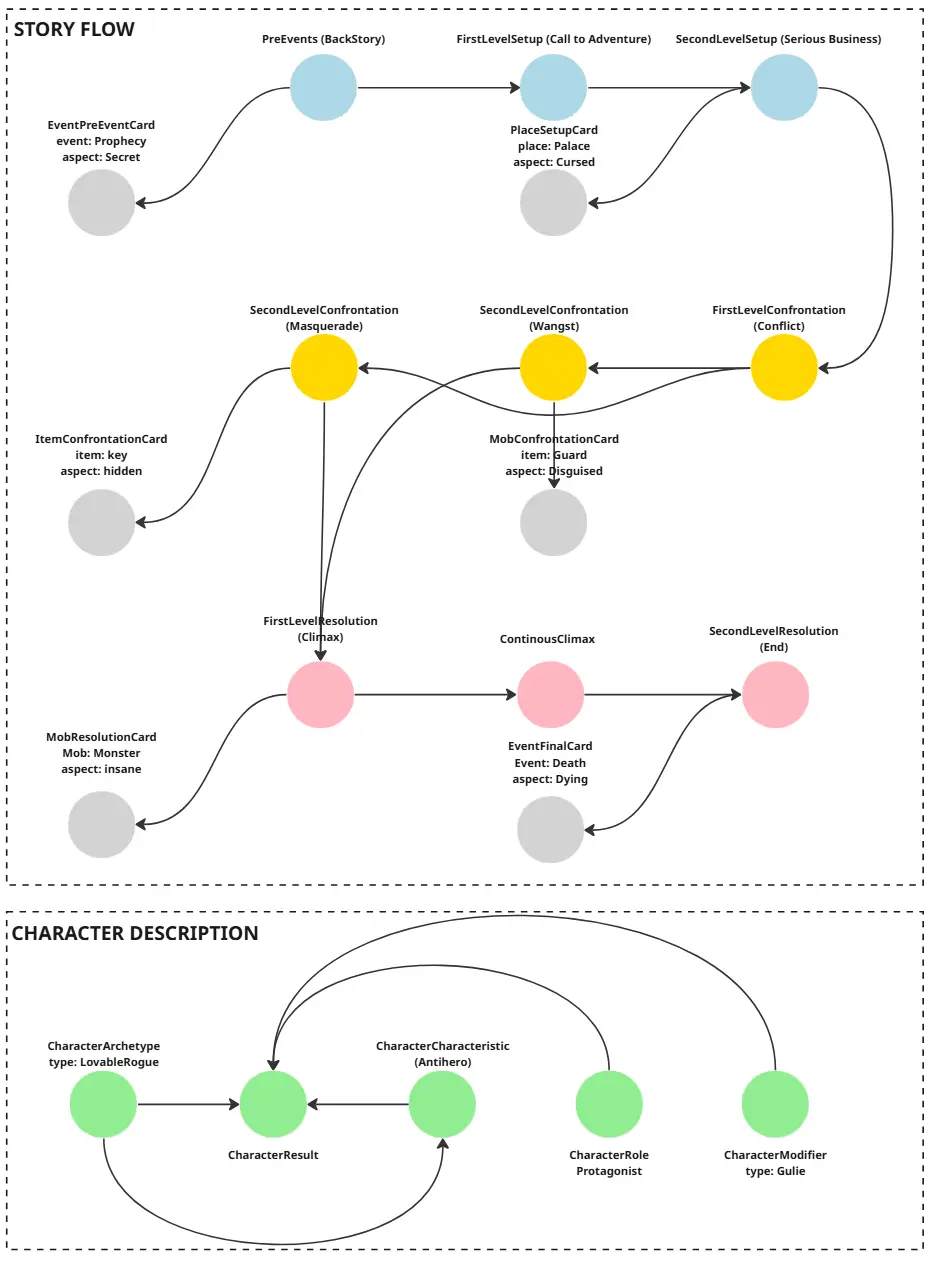
Stories are internally represented as graph-based structures, where nodes correspond to narrative states or events and edges define branching, causal, and temporal relationships. This allows the system to model acts, story nodes, optional quests, alternative paths, and player-driven progression in a way that is compatible with interactive storytelling design.
Human-AI Co-Creation
A central contribution of the thesis is the positioning of AI as a co-creative support system rather than an authoring replacement. The tool is designed to accelerate ideation, assist structural planning, and reduce repetitive design work, while leaving all high-level creative decisions under human control.

Use arrows to browse media